Mortgages
How do I get a mortgage and pay it off?
This 9,500-word Epic Guide to Mortgages is the definitive article on how to get a mortgage and pay it off faster, today in 2026. The Ultimate Guide.
Mortgages
10 min read

Even for people who are familiar with what it is … revolving credit can be complex to grasp.
But once you get your head around it, revolving credit is a powerful tool that will help you pay down your mortgage more quickly.
You might have heard it works “like an overdraft” … but what does that mean? And how does it work?
A revolving credit mortgage is like a big bank account with a large overdraft. You can take out money, put it back, and keep doing this as long as you stay within your limit. Interest is charged every day, so if you put your paycheck into it, you can lower your loan amount for some time and save on interest costs.
In this article, you’ll learn exactly what a revolving credit is, how you set one up, and if using one could be the right strategy for you and your portfolio.
Do you have a question or comment about revolving credits? Feel free to leave your thoughts in the comment section at the end of the page.
A revolving credit mortgage is a single account that works like an overdraft on a home loan rate, where you only pay interest on the balance you still owe.
A revolving credit is a type of mortgage, where a small part of your home loan acts like an overdraft.
But, if you convert part of your mortgage into a revolving credit – it’s an overdraft that’s already maxed out, and you still have to pay back.
Here’s how it works.
Let’s say you have a $500K mortgage. Now, chip off a chunk of that mortgage – say $10K … that’s your revolving credit.
But, rather than have a 15% interest rate like some other loans and overdrafts, it’s on a home loan rate, which is 4% or 5% in today’s money.
However, you only pay interest on money outstanding, not the money you have paid back.
So, if you have a $10K revolving credit, but have managed to put $4K in that account, you only pay interest on the outstanding $6K.
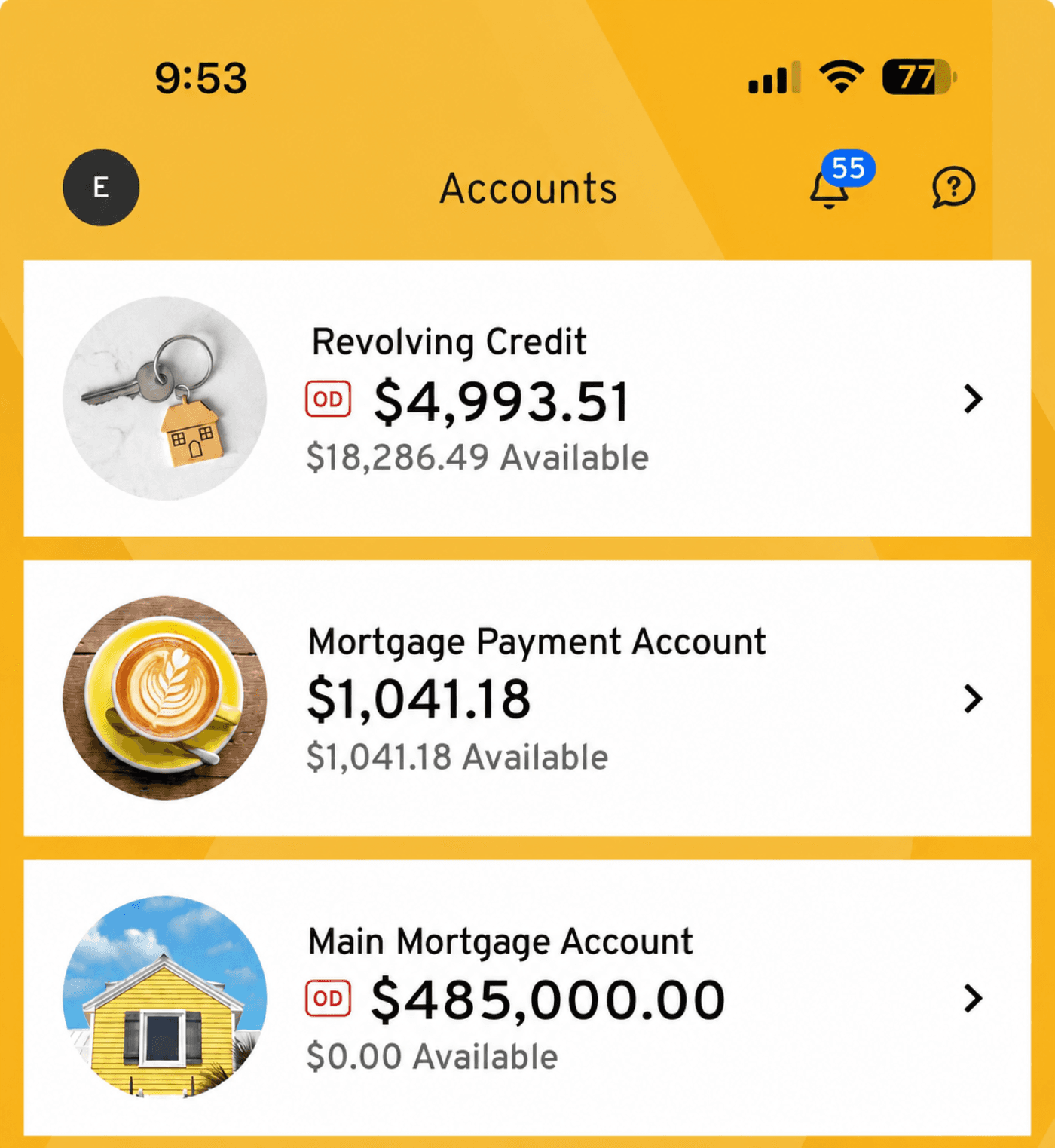
There are two types of revolving credit:
Effectively, a reducing revolving credit is like a Principal and Interest loan, where you are slowly forced to pay it off. For instance, over 30 years.
A non-reducing revolving credit is like an interest-only loan, where the size never decreases.
The danger with a non-reducing revolving credit is that you never pay it off and you have the revolving credit forever … if you’re not disciplined enough. But we get to that later.
| Type | What it means |
| Reducing | Your available limit reduces over time, so you are gradually forced to pay it down (it’s like a standard principal-and-interest loan) |
| Non-reducing | Your limit stays the same, so you need to be disciplined about paying it down yourself (like an interest-only loan) |
As a rough guide, revolving credit limits often start from around $5,000 and can go up to about $200,000–$250,000, depending on the bank and your situation.
Before we get into the detail, here’s how you use a Revolving Credit to pay off your mortgage more quickly.
In its simplest terms, you use it as a goal-orientated savings plan.
Alongside making minimum mortgage repayments, you start putting any and all spare cash into your revolving credit – to pay it down quickly.
If you stick to the plan you’ll pay off the revolving credit and use that money to make a lump-sum payment off your mortgage.
Then you rinse and repeat until you’ve paid off your mortgage.
This is called the Mortgage Buster strategy.
There are additional benefits (as well as drawbacks) but as you pay money into the revolving credit, you reduce the interest you’re charged. But, like an overdraft, you can also take that money out at any time.
Let’s get into the pros and cons.
The simplest way to think about a revolving credit is as a goal-based savings plan for your mortgage.
Here at Opes we call this the Mortgage Buster strategy.
Instead of waiting until you’ve saved a lump sum to pay extra off your mortgage, you create that lump sum upfront using a revolving credit.
| Step | What happens |
| 1 | Set up a ~$15,000 revolving credit (choose a limit that suits you) |
| 2 | It immediately reduces your main mortgage by $15,000 |
| 3 | Put your spare cash into the revolving credit until it’s paid off |
| 4 | Once it’s repaid, take that money and use it all to pay off your bigger mortgage |
| 5 | Repeat the process |
For instance, let’s say you can put an extra $300 away a week. This adds up to $15,600 in a year, but we’ll say $15,000 to keep things simple.
If your mortgage was $600k, putting an extra $15,000 a year towards it could save about $279k in interest over the life of the loan.
That would help you become mortgage-free about 13 years earlier.
That’s based on a 5% interest rate and 30-year mortgage.
By setting up your mortgage this way you are setting yourself a goal of how much extra you want to save in a year.
However, revolving credits give you more flexibility compared with just committing to a higher repayment. That’s because you can take money in and out as easily as a transaction account.
There are different ways investors can set up their revolving credit. One way is to keep it separate from your normal spending account, then just use a revolving credit to park your savings.
Another way is making your revolving credit account your normal everyday spending account.
Here’s how that second option works:
Let’s say you earn $2,000 a week.
Step 1: You start with a revolving credit balance of -$15,000.
Step 2: Your salary lands in the account. That immediately reduces the balance to -$13,000.
Step 3: During the week your bills and spending come out of the account. As that happens the balance starts moving back towards -$15,000.
But interest is calculated every day, then charged once a month. So any money you have in there saves you interest (as long as it’s in your account).
Step 4: At the end of the week you might have $300 left in there, so the balance is reduced to -$14,700.
Step 5: The next week your salary lands again and the cycle repeats. Over time that leftover $300 a week steadily pays the revolving credit down towards zero.
If you ask a mortgage broker, most will say everyone should use a revolving credit … but only if you use it properly.
Here’s why.
Revolving credits are flexible. In technical terms, they are liquid.
Any money you put in can be taken out, the same as any other bank account.
That’s why many borrowers will put all their salary and wages into their revolving credit, and then pay their expenses out of this account.
While they have money in there, the amount of interest they pay is temporarily reduced.
Some investors find this flexibility really pushes them to pay down that mortgage more rapidly, with the comfort of knowing that you can access that money in an emergency.
For instance, if you’ve managed to put $10,000 into your revolving credit but then your car breaks down – you can take that money back out to cover repairs.
If you were to do that with your standard P+I loan, not only are you limited to how much extra you can pay back (5% for most banks without incurring fees) you will have to apply to get that money back out if you need access.
| Pros | Cons |
| Flexible – money you put in can usually be taken back out again. | Higher interest rate – revolving credit is usually on a floating rate, which is often higher than fixed rates. |
| Can reduce interest – while your salary or savings sit in the account, they reduce the balance you’re charged interest on. | Easy to overspend – because the money is available, some borrowers keep redrawing it. |
| Useful in emergencies – if your car breaks down or an unexpected bill comes up, you may be able to access the money again. | Not suited to the whole mortgage – most people only use revolving credit for a smaller portion of their loan. |
Revolving credits come on a floating interest rate. On average floating rates have historically been about 0.91% higher than the one-year fixed mortgage interest rate (2002 – 2022).
So, on average, you’ll pay a bit more in interest if you use a revolving credit.
This is why you wouldn’t set up your entire mortgage on revolving credit, even if you could (you often can’t btw), because then you'd be paying the whole mortgage on a much higher interest rate.
That’s why your mortgage broker will advise on an appropriate revolving credit amount.
Said another way, a mortgage broker will help you figure out what you can realistically afford to pay back to help make some headway on paying off a mortgage.
The minimum amount is $5,000, and the maximum is $200K to $250K, depending on the bank.
Yes, you are going to pay a higher interest rate on your revolving credit, but once you make that repayment back into you mortgage account you are going to save some pennies on interest there.
The best way to use a Revolving Credit to pay down your mortgage faster is to use the Mortgage Buster strategy.
Put simply, the strategy is to use a revolving credit to make extra discretionary payments on your mortgage to pay it down more aggressively.
In turn, this increases the amount of equity you have in a shorter period of time – so you can buy more investment properties.
It also decreases your debt, so it improves the income and expenses side of your mortgage application.
The best action plan is to go through a mortgage adviser, but you can go directly to your bank.
The first step is to figure out how much extra money you can realistically put towards paying off your mortgage within a year. That’s the amount you’ll set your revolving credit up for.
For instance, let’s say you can put an extra $300 away a week. This adds up to $15,600 in a year.
In this instance, you’d typically break off $15K from your mortgage (we’ve rounded for simplicity) and put it in the revolving credit.
This revolving credit now works like a transactional account. All your wages go into it, and all your bills go out. What’s left stays in there and gradually pays it off.
The available balance starts at zero. So, you save $300 one week and you’re at $300; in a month you’re at $1200 … and so on.
At the end of the year, when you reach your $15,000, you put this entire amount back into your main mortgage.
Here’s a graph that models how much more quickly you can end up paying your mortgage off by using revolving credits.
| Revolving credit | Offset | |
| How many accounts | 1 | 2 |
| How it works | Your mortgage works like a big overdraft. Money goes in and out of one account. | Your mortgage sits in one account, while your savings sit in separate linked accounts. |
| Best for | People who are disciplined with money and live by a budget. | People who like to bucket money into separate accounts. |
| Commonly used for | Personal mortgages | Investment mortgages |
| Main risk | Easy to spend the money again. | You may still need to make repayments, even when fully offset. |
By setting up your mortgage this way you are setting yourself a goal of how much extra you want to save in a year.
However, there is much more flexibility than with say a higher repayment or a loan, because you can take money in and out as easily as a transaction account.
| Bank | Revolving credit | Offset account |
| ANZ | Yes: Flexible Home Loan | No |
| ASB | Yes: Orbit | No |
| BNZ | Yes: Rapid Repay | Yes: TotalMoney |
| Kiwibank | Yes: Revolving | Yes: Offset home loan |
| Westpac | Yes: Choices Everyday | Yes: Offset available |
It’s important to note, a revolving credit is going to be just one part of your overall strategy to pay down debt.
Generally speaking, the set-up for an investor will look something like this:
A revolving credit may suit you if you:
It may not be the right fit if you:

Mortgage broker for over 10 years, property investor and Managing Director at Opes Mortgages
Peter Norris, a certified mortgage adviser with 10+ years of experience, serves as the Managing Director at Opes Mortgages. Having facilitated over $1.2 billion in lending for 2000+ clients, Peter is a respected authority in property financing. He's a frequent writer for Informed Investor Magazine and Property Investor Magazine, while also being recognized as BNZ Mortgage Adviser of the Year in 2018 and listed among NZ Adviser's top advisers in 2022, showcasing his expertise.
This article is for your general information. It’s not financial advice. See here for details about our Financial Advice Provider Disclosure. So Opes isn’t telling you what to do with your own money.
We’ve made every effort to make sure the information is accurate. But we occasionally get the odd fact wrong. Make sure you do your own research or talk to a financial adviser before making any investment decisions.
You might like to use us or another financial adviser